English
 Chinese
 Pусский
 España
 Deutsch
 Français
 Português
Guide to Cutting Jumbo Rolls into Custom Widths for OEM
You‘ve purchased a jumbo roll of medical tape—maybe 1.2 meters wide, 4,000 meters long. The plan is to slit it into 2‑inch rolls for the sports medicine market. But when the slitting line runs, the edges are ragged. The adhesive oozes out the sides. The roll feels uneven. You’ve just learned the hard way that not every tape slits the same way.
A jumbo roll is the starting point for every adhesive tape product on the market—surgical tape, sports tape, kinesiology tape, elastic bandages, and more. For OEM buyers and tape converters, the slitting process determines the quality of the finished product. Get it right, and you have clean edges, consistent roll lengths, and satisfied customers. Get it wrong, and you scrap half the roll. This guide walks through the key parameters: understanding jumbo roll construction, tension control, blade selection, common OEM widths, edge quality, packaging requirements, and quality checks. Whether you‘re a first‑time converter or an experienced OEM buyer, these are the questions you need to ask before you cut.
Understanding jumbo roll construction for different tapes
Not all jumbo rolls are the same. The core type, tape thickness, and substrate all affect how the roll should be slit.
Core types and their impact on slitting
Jumbo rolls typically come with either 3‑inch paper cores or 6‑inch plastic cores. Paper cores are lighter and more economical, but they can crush under high tension—especially on wider rolls. Plastic cores hold their shape better and handle higher tension, making them the preferred choice for heavier tapes like elastic bandages and cloth‑backed sports tapes.
The core inner diameter also matters. Most slitting machines are designed for standard core sizes; if your jumbo roll has a non‑standard core, you‘ll need adapter chucks.
Tape thickness and maximum slit count
A jumbo roll‘s thickness determines how many finished rolls you can get from a single master roll. Thinner tapes—like 0.4mm surgical tape—allow more layers per roll, so you can slit more smaller rolls from the same jumbo. Thicker tapes—like 1.2mm sports tape or elastic bandages—take up more space per layer, reducing the number of rolls you can produce.
This affects both yield and machine setup. For a 4,000m jumbo roll of 0.4mm surgical tape, you might get 500 finished rolls of 8m length. For a 1.2mm sports tape, that same 4,000m might only yield 160 rolls. Plan your production run accordingly—and check with your supplier on the tape‘s thickness before ordering.
Key machine parameters when slitting adhesive tapes
Three machine parameters determine slitting quality: tension, blade type, and speed. Each varies by tape type.
Tension control—elastic tapes need less
Tension control is the single most important variable in tape slitting. Too much tension stretches the tape; when it relaxes after cutting, the roll becomes distorted and the edges curl. Too little tension causes loose winding and telescoping—where the layers shift sideways.
For elastic tapes (kinesiology tape, elastic bandages), use lower tension with tapering control—reducing tension gradually as the roll builds in diameter. For non‑elastic tapes (surgical tape, PE tape), higher tension is acceptable, but still keep it consistent across the entire run.
Blade type—razor vs. shear
The blade type must match the tape construction. Razor blades (score‑cut) work well for thin, non‑woven tapes and films—they make clean cuts with minimal waste, but they dull quickly on abrasive substrates. Shear blades (rotary) are better for thick, cloth‑backed tapes and elastic materials—they cut through the fabric without fraying edges.
For zinc oxide tape with cotton cloth backing, shear blades are the standard. For thin PE or non‑woven surgical tape, razor blades are faster and more economical.
Speed recommendations
Typical slitting speeds range from 200–300 meters per minute. At higher speeds, the blade generates friction heat—which can soften adhesive and cause edge oozing. If you‘re running a heat‑sensitive tape (like certain medical adhesives), run at the lower end of the range or use cooling blades.
Common custom widths ordered by B2B customers
OEM buyers order a range of widths depending on the application. Below is a reference for the most common widths and their typical uses:
| Width (inches) | Typical Use | Market Segment |
|---|---|---|
| 0.5 inch | Finger wraps, small wound coverage | First aid, sports |
| 0.75 inch | Toe wraps, small joint support | Podiatry, sports |
| 1 inch | General wound dressing, minor sprains | First aid, clinic |
| 1.5 inch | Wrist support, small joint taping | Sports medicine |
| 2 inches | Ankle taping, moderate sprains | Sports medicine, clinic |
| 3 inches | Knee support, larger joint taping | Sports medicine, orthopedic |
| 4 inches | Thigh/torso coverage, compression wraps | Orthopedic, hospital |
The specific widths your customers order will depend on their end‑use. A sports clinic might order mostly 1.5‑inch and 2‑inch rolls; a hospital might need 3‑inch and 4‑inch for post‑surgical compression.
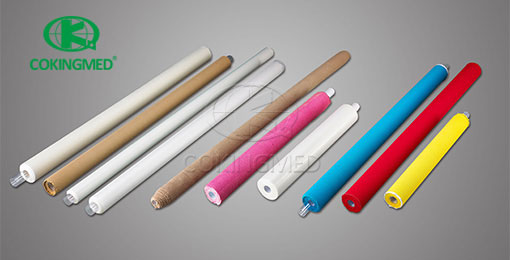
For OEM buyers, the ability to supply multiple widths from the same jumbo roll reduces inventory complexity. Cokingmed offers jumbo rolls across multiple tape types—non‑woven tapes, PE tapes, zinc oxide tapes, kinesiology tapes, and elastic bandages—all of which can be slit to custom widths.
Dealing with edge buildup and adhesive oozing
Two common defects appear during slitting: edge buildup (adhesive accumulating at the cut edge) and adhesive oozing (adhesive squeezing out the side of the roll).
What causes edge buildup and oozing
Both problems trace to excessive heat at the cutting blade. When the blade runs too fast or dulls, friction generates heat. That heat softens the adhesive, which then flows to the cut edge and builds up. The problem is worse on tapes with aggressive adhesives (like zinc oxide or kinesiology tape) and thicker substrates.
Solutions
If you see adhesive buildup at the cut edge, reduce the feed rate by 10–15% and check blade sharpness. A dull blade generates more heat than a sharp one—replace blades more frequently on high‑adhesion tapes. For long runs, consider using a cooling blade system or an air blast that cools the blade during operation.
Some converters also adjust the blade angle—a shallower angle reduces friction and heat. Test different angles on a sample before committing to a full production run.
Packaging and labeling for slit rolls
Finished rolls need proper packaging to protect them during shipping and storage. The requirements depend on the tape type and the end customer‘s expectations.
What to include on each roll
Every finished roll should have a label with:
-
Width (in inches or mm)
-
Length (in meters or yards)
-
Batch number (for traceability)
-
Production date
-
Tape type or product code
Batch numbers are critical for medical tapes—if a quality issue arises, you need to trace it back to the specific jumbo roll and production run. Cokingmed‘s quality certifications (CE, FDA, ISO, BSCI) ensure that each batch meets international standards.
Recommended packaging
For most medical and sports tapes, individual poly bags plus a cardboard box provides adequate protection. The poly bag keeps the tape clean and dust‑free; the box prevents crushing during shipping. For tapes with aggressive adhesives (zinc oxide, kinesiology), consider adding a release liner between layers to prevent blocking—where the adhesive sticks to the back of the next layer.
Barcode labeling for inventory management
Barcode labels on each finished roll simplify inventory tracking for your customers. Include the width, length, and batch number in the barcode—this allows your customer to scan rolls into their inventory system without manual data entry.
Quality checks after cutting
After the slitting run, perform these quality checks before packaging. Catching defects now saves customer complaints later.
Visual edge inspection
Examine the cut edges of several rolls from the run. The edge should be clean and straight, with no fraying, raggedness, or adhesive buildup. If you see uneven edges, the blade needs adjustment or replacement.
Unroll test for adhesion and blocking
Unroll the first meter of a finished roll and inspect for blocking—where the adhesive sticks to the back of the tape and makes unrolling difficult. For medical tapes, blocking is a common complaint; it makes the tape hard to apply in clinical settings. If you find blocking, the winding tension was too high or the tape wasn‘t cooled sufficiently before winding.
Length verification by weight
Weigh a finished roll and compare the weight to the expected weight based on the tape‘s basis weight and the specified length. If the roll is significantly underweight, the length is short. If it‘s overweight, the tape may be thicker than spec or the winding tension is uneven.
Buyer‘s questions for tape suppliers
Q: What is the maximum width of a jumbo roll?
A: For most medical and sports tapes, jumbo rolls range from 1000mm to 1600mm wide. Cokingmed supplies jumbo rolls in various widths depending on the tape type. The maximum width affects your slitting layout—wider rolls allow more lanes per pass, improving efficiency. Check with your supplier on the specific width available for your tape type.
Q: Can you provide jumbo rolls already slit into mixed‑width sets?
A: Yes—this is a common OEM service. Instead of shipping a single wide jumbo roll, some suppliers can pre‑slit the roll into a set of different widths (e.g., one 2‑inch roll, two 1‑inch rolls, etc.) that are all wound onto separate cores. This saves you a slitting step and reduces your equipment requirements. Cokingmed offers OEM services and semi‑finished jumbo roll production, making this a practical option for buyers without in‑house slitting capacity.
Q: What is the recommended storage life for jumbo rolls?
A: Most medical tapes have a shelf life of 2–3 years from the date of manufacture when stored properly. Storage conditions matter: keep jumbo rolls in a cool, dry environment away from direct sunlight and extreme temperatures. High humidity can affect the adhesive properties; low humidity can make the tape brittle. Check with your supplier for the specific shelf life of each tape type.
How Cokingmed supports OEM tape converters
Cokingmed (KEKANG Medical) is a professional manufacturer specializing in medical breathable tape, sports tape, spunlaced non‑woven fixation tape, and related products. The company produces a wide range of jumbo rolls including non‑woven tapes, PE tapes, zinc oxide tapes, kinesiology tapes, and elastic bandages.
Quality certifications include CE, FDA, ISO, and BSCI, ensuring that every jumbo roll meets international medical and safety standards. The company‘s TUV ISO13485 certification provides additional assurance for medical applications where regulatory compliance is mandatory.
Cokingmed operates a 15+ year expert R&D team specializing in medical tapes, self‑adhesive bandages, and sports tapes. Raw materials are selected for safety and skin‑friendliness, with rigorous testing using advanced equipment and laboratory systems. The company introduced an imported American coating line in 2021, significantly improving coating uniformity and production capacity.
For OEM buyers and tape converters, Cokingmed offers custom solutions from research and material sourcing through manufacturing and testing. Whether you need standard jumbo rolls or semi‑finished products ready for slitting, the company‘s flexible approach supports both large‑scale production runs and smaller custom orders.
Before you place your next jumbo roll order, confirm the tape thickness, recommended slitting speed, and blade type with your supplier. Request a 1‑meter sample for a trial slit—it‘s the best way to verify that the tape will perform as expected on your equipment. A few minutes of testing now prevents hours of scrap later.
Ready to source jumbo rolls for your OEM tape converting operation? Contact Cokingmed for a quote or to request a 1‑meter sample roll for trial slitting. Share your target tape type (surgical, sports, kinesiology, or bandage), required finished widths, and annual volume—their technical team can recommend the right jumbo roll configuration for your slitting line.