English
 Chinese
 Pусский
 España
 Deutsch
 Français
 Português
Can your sports tape survive a full match without peeling or losing tension?
Can your sports tape survive a full match without peeling or losing tension?
You tape an athlete’s ankle before the final. The strapping looks perfect. Ten minutes in, sweat softens the adhesive, and the joint finds the range of motion you were trying to block. The sports tape didn’t fail because you applied it wrong. It failed because the tape wasn’t matched to the injury phase.
This article covers two distinct categories of sports tape: rigid zinc oxide strapping tape for acute mechanical restraint, and elastic kinesiology tape for neuromuscular and lymphatic effects. It also discusses sweat resistance, breathability, and hypoallergenic considerations.
Rigid zinc oxide sports tape: mechanical restraint for acute injury
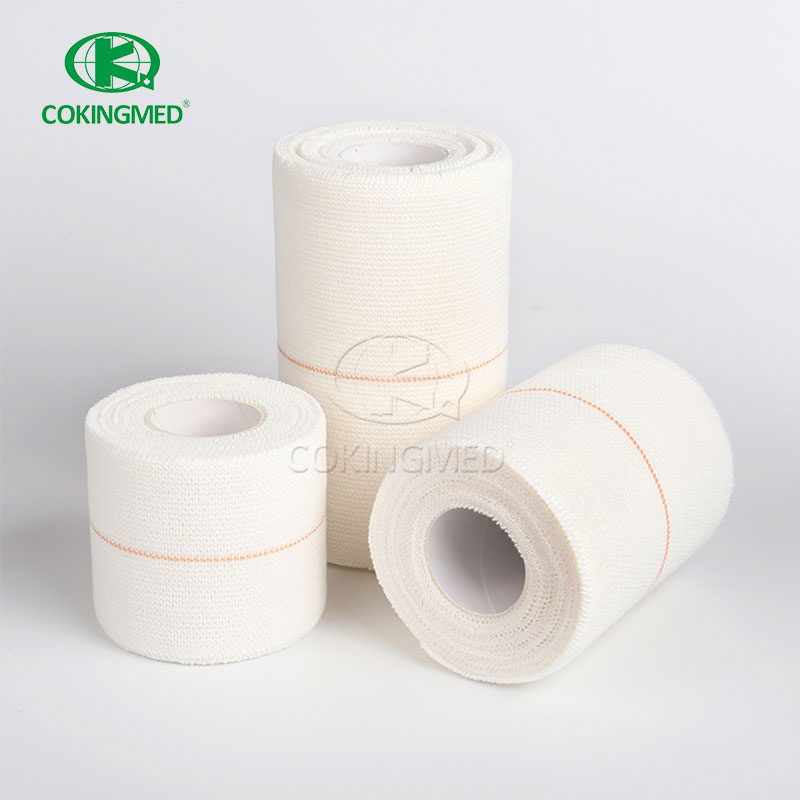
A rigid sports tape uses a woven cotton backing and a zinc oxide‑based adhesive. It does not stretch. When applied across a joint—for example, the anterior talofibular ligament of an ankle—it physically blocks the last 5‑10° of inversion.
This tape is indicated for acute injury phases (first 48‑72 hours) and for athletes with a history of recurrent instability. It acts as an external ligament. It does not improve strength or flexibility; it simply adds a mechanical stop.
What happens if you apply rigid tape over swollen tissue
Edema under the tape causes shear blistering. The skin moves relative to deeper fascia, but the tape stays fixed. The result is epidermal separation. For acute swelling, place a foam underwrap or elastic bandage under the rigid tape.
Elastic kinesiology tape: neuromuscular and lymphatic mechanisms
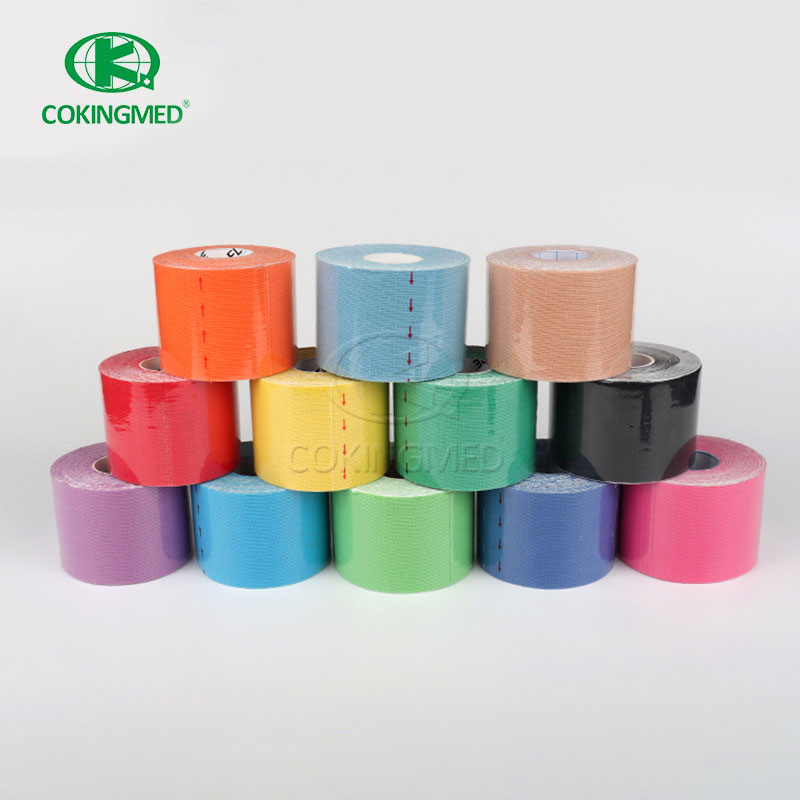
Elastic kinesiology tape uses a polyurethane‑cotton blend backing that stretches to 40‑80% of its resting length. The adhesive is medical‑grade acrylic, applied in a wave pattern to allow moisture vapor transmission.
When applied with 15‑25% stretch, the tape microscopically lifts the skin, increasing interstitial space and encouraging lymphatic drainage. It also activates cutaneous mechanoreceptors, providing proprioceptive feedback and reducing pain signal transmission (gate control theory).
| Stretch Applied | Primary Effect | Clinical Indication |
|---|---|---|
| 0‑5% | Skin lift, lymphatic drainage | Edema, bruising |
| 15‑25% | Proprioception, mechanoreceptor activation | Joint position sense, muscle re‑education |
| 30‑50% | Facilitatory input to muscle | Quadriceps facilitation in ACL rehab |
| >50% | Inhibitory input, pain gating | Hypertonic muscle, spasticity |
This type of sports tape is indicated for sub‑acute and chronic phases, muscle facilitation/inhibition, and pain modulation (e.g., patellofemoral pain, Achilles tendinopathy).
Adhesion in sweat and water: what the spec sheet means
Both rigid and elastic tapes claim sweat‑resistant and water‑resistant performance.
What “water‑resistant” actually means
The acrylic adhesive maintains shear adhesion when saturated with sweat or briefly submerged. Extended immersion (>30 minutes) or high‑intensity sweating without evaporation will soften the adhesive. For kinesiology tape worn 3‑5 days, showering is acceptable; swimming for an hour is not.
For rigid zinc oxide tape, an elastic adhesive bandage overwrap protects the tape from direct sweat exposure.
Breathability and maceration risk
The wave‑pattern adhesive on kinesiology tape allows moisture vapor transmission, reducing maceration (softening of the stratum corneum) during multi‑day wear.
Hypoallergenic claims and ISO 10993 testing
“Hypoallergenic” is meaningful only if the tape has passed ISO 10993 biological safety tests: cytotoxicity, skin irritation (rabbit model), and skin sensitization (guinea pig maximization test).
Coking Medical’s sports tape has passed these evaluations. This matters for patients with known adhesive allergies (colophonium, certain acrylics), for neonatal/geriatric fragile skin, and for extended‑wear applications.
Three clinical checks before stocking a new sports tape brand
Check 1 – Peel adhesion under wet conditions
Apply tape to dry forearm. After 2 hours, peel at 180° and note pain. Apply a second strip, wet the arm, pat dry, then peel. Moisture should reduce adhesion by no more than 30%.
Check 2 – Residue inspection
After peeling, examine the skin under a 10x loupe. Visible residue means the adhesive‑backing bond is weaker than the adhesive‑skin bond. Repeated residue leads to irritation and extra cleanup time.
Check 3 – Stretch consistency across the roll
For kinesiology tape, stretch a 10cm strip to its maximum elongation. The force should be uniform along its length. Variation indicates poor manufacturing and predicts inconsistent clinical effect.
Where Coking Medical’s sports tape range fits into a clinical or athletic training setting
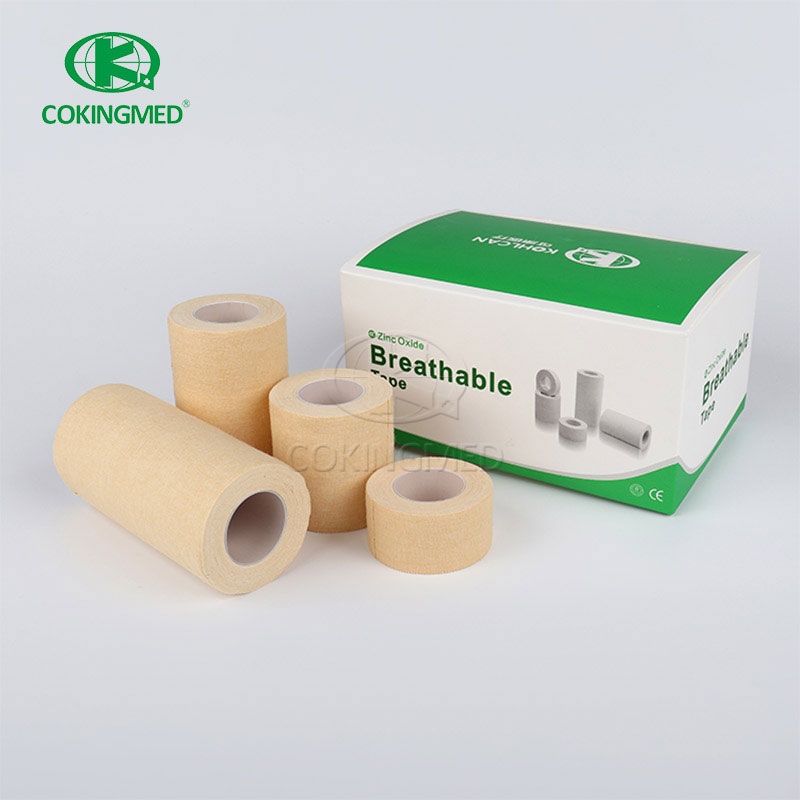
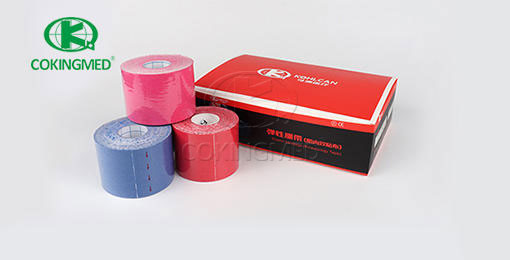
Coking Medical manufactures both rigid zinc oxide tape and elastic kinesiology tape under ISO 13485, with CE marking and FDA registration. The rigid tape is available in widths of 2.5cm, 5cm, and 7.5cm; the kinesiology tape is supplied in 5cm × 5m rolls, available in beige, black, blue, pink, and skin tones.
For a sports medicine clinic, stocking both systems allows the clinician to select rigid tape for acute inversion sprains and kinesiology tape for patellar tracking or post‑match recovery. For an athletic trainer covering a team, the water‑resistant adhesive keeps strapping intact through a full game. A reliable sports tape is the difference between an athlete finishing the season and watching from the sideline.